Tuesday, October 13, 2015

Star Wars Reads Day 2015

Guys, it's been awhile.  It's not that I haven't had interesting library stories to tell, it's just that I've been too busy to stop and tell them.

But I like to document what I've done, and since I don't believe in reinventing the wheel I think it's important that I contribute to the conversation in case someone else out there might be able to benefit from my experience.  So I'm going to try and start this up again.  Bear with me as I try to get back in the swing of things.


To kick things off, I want to talk a bit about Star Wars Reads Day.  We participated in this awesome national event for the third year in a row, and this was by far our best year yet.  We had huge attendance, which was a bit surprising because the weather was so beautiful and I know we actually lost several families to the pumpkin farm as a result.  Many of the activities were the same ones I had used in years past (balloon lightsabers, fortune Wookies, stick puppets, word search, trivia, memory, and a checklist to keep it all straight), which made planning super easy.  I did revamp an old favorite activity and added two new ones to keep things interesting:

Yoda Ears and Princess Leia Buns 

 
I borrowed this idea from Amy at Catch the Possibilities.  I made my own templates because I wanted to tweak Amy's design and printed the ears and buns off on construction paper.  I also cut two-inch strips of paper that could be fashioned into headbands.  The kids could cut out the ears/buns themselves, and then make headbands.  The Yoda ears were the most popular of the two options, but I was glad to have two different choices for this activity.

Scavenger Hunt


The scavenger hunt has been an old standby for the past few years, and while the kids love it and I love how it gets them to visit all areas of the library, I wanted to change things up a bit.  I borrowed the new format for the hunt from that same blog post that I linked to above and tweaked it just a bit.  I found pictures of eleven different characters and used Publisher to put a letter of the alphabet with each one.  These were cut out, laminated, and hung around the library.  Each kid got a worksheet that listed all of the places where they needed to look to find characters.  When they found the character, they needed to write down the corresponding letter of the alphabet in the appropriate box.  When all were found, they had a message from Master Yoda.  The kids could turn in their completed worksheets and get a bookmark as a prize.

Costumed Characters


This year, thanks to one of our awesome library regulars, we finally were able to get a few awesome members of the local 501st and Rebel Legion to join us for our celebration.  These guys were a big hit!  They spent two full hours in costume hanging out with the kids, taking pictures, watching the kids put on shows with their puppets, and generally just being awesome.  As a bonus, these organizations always advertise through their own outlets where they will be making appearances, so we got a little extra advertising for our event by working with them.  I know of at least two families who came to the library that day specifically because they had seen that the 501st would be there through their Facebook page.

Notes about costuming:

Yes, that's me in the Princess Leia costume.  I like to let my geek flag fly a bit at events like this.  :)

The clone trooper and Sabine (the two characters on the right in the above picture) were my contacts with the 501st and Rebel Legion.  They are parents to one of our long-time library regulars, and dad (the clone trooper) joined up with both organizations last year.  Mom, who is the parent we usually see, just completed her costume and I think might be joining the Rebel Legion in an official capacity soon.  Having people that we know who were already invested in the library as a contact was a huge help!  I was able to talk with our trooper friend before I submitted my request for characters to appear at the library to find out what times work best for people and when other groups were having their events that day to maximize the likelihood that we'd get a good response.  You certainly don't need to have a personal contact like this if you want to try to get the 501st and/or Rebel Legion to make an appearance at your event, but having this personal contact had some nice perks, especially since there are so many local events on Star Wars Reads Day.

Wednesday, May 27, 2015

Passionate Reading

Today I visited the 6th grade classrooms at our local school to talk about the Summer Reading Program.  After giving my spiel, a boy raised his with a question which resulted in the following dialogue:

"So I can read any book that I want this summer and it counts?"
"Yup, you can read absolutely anything you want."
"So if I want I can read medical textbooks?"
"Yes, you can read anything you want."
"YES!  I can read medical books!"

No sarcasm.  This kid apparently actually has a passionate interest in the medical.

This brings up a great point to remember about summer reading:  Part of the beauty of summer break is that kids no longer have teachers breathing down their necks to do specific kinds of work.  Summer is a great chance for kids to take a break from scheduled learning and instead focus on whatever it is that they are passionate about.  They can reread their favorite books for the hundredth time.  They can learn to juggle.  They can read about zombies or LEGOs.  They can learn even more about something cool they learned in school, or they can learn about something cool that their teacher doesn't have the time or ability to teach them.  Summer is a time when kids can become experts about whatever it is they like with no questions asked.

How cool is that?

So parents, it's okay to let your kid relax a bit this summer.  Let them dictate how their reading time is spent.  As long as they do at least some reading, they'll be the better off for being able to take some ownership of the effort.

Thursday, April 23, 2015

You Just Won't Have Time

A fourth grade girl was at the library with her family.  She selected a pretty big stack of picture books to take home.  I overheard mom's reaction when she saw the books:

"Don't take those books.  They're too quick to read, and you just won't have time to read them all."

The logic is lost to me.

Banana Keyboards


I found a half-finished version of this post saved as a draft in my blog's archives.  Oops!  I took a few minutes to finish writing and add a few pictures.  It's a bit belated, but enjoy!

This month's Maker Monday program delved a bit more into the tech than past programs as we experimented with a Makey Makey.

What is a Makey Makey?  Well, it's a nifty little device that can connect to a computer via USB.  You then can connect other objects to the Makey Makey to create your own custom keyboard using alligator clips.  Any object that conducts electricity would work fine:  Fruits, vegetables, houseplants, play-dough, other people, or even water.  Couple this with a few simple web programs that utilize the arrow keys and suddenly you can capture Pokemon with potatoes, play a tune on the piano with play-dough, win at Tetris with bananas, or drum a wicked beat on a houseplant.  The possibilities are limitless.

Jay Silver, one of the creators of the Makey Makey also gave a really awesome Ted Talk about his inspiration for the device, which I really recommend watching.  I did not show the video as part of my program due to time constraints, but it would be great to share if time allows because it helps get everyone into the proper mindset for thinking outside the box.  Enjoy it here:


I purchased a Makey Makey starter kit for $50, which comes with everything you need to get started.  You can find the kit for sale on Amazon, or you can buy directly from the Makey Makey website.  I also definitely recommend exploring the Makey Makey website to get lots of ideas for way that the device can be used.  They have links to a whole list of awesome recommended programs that work well with the Makey Makey, which is a great place to start.

Since only so many people can use the program at once, I decided to limit the size of the program to 5 people at a time with two time slots, one for teens and another for tweens.  Neither group completely filled (I had 4 teens and 2 tweens), but I was actually thankful for the small numbers as we tested what the Makey Makey could do.

On the day of the program, I set up a laptop and connected the Makey Makey.  I pre-loaded a couple of programs that I knew I wanted to try out (piano and bongos) so that they would be ready to go, and kept another tab open with the list of recommended programs to give us more options.  I set up another table with some conductive object to connect to the Makey Makey.

When the teens/tweens arrived, I have them a quick 2-minute rundown of what the Makey Makey was and how it worked.  Then I basically just let them go to town.  I let them decide which programs they wanted to test and which objects they wanted to turn into their keyboards and only offered a bit of advice and encouragement when it looked like they needed it, and occasionally challenged them to try something a little bit different or reminded them to take turns.  With such a small group, it was very easy to just let them experiment with the Makey Makey to discover what they could do with it.  As the afternoon progressed, everyone started to get even more creative and innovative as they tested the Makey Makey's limits.  It was awesome.

Check out these pictures to see some of the ways that the teens/tweens got creative with the Makey Makey.


Monday, April 6, 2015

Two Book Displays

Our book displays have been especially lovely lately.  I give full credit for this to my co-workers, who are very good at making these displays look extra-special.

The first display was done with lot of basketball books, both fiction and non-fiction, in honor of the NCAA basketball tournament.  The popularity of this display was, no doubt, helped by the Wisconsin Badgers' incredible run.  The big Badgers flag came from a staff member's house, and we posted an updated copy of the bracket every few days.


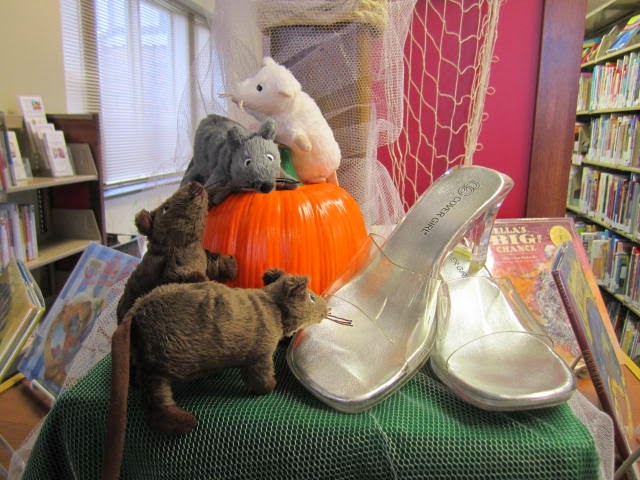
The second display was full of lovely Cinderella stories, in honor of the recent release of Disney's live-action movie.  The staff memeber who set this display up brought in her own shoes to use as the "glass slippers," and the mice and pumpkin came from our stash of storytime supplies.


Thursday, April 2, 2015

Maze

We've started doing passive programming in the children's area of my library quite recently, and the month of March was my turn to create one of these programs.  Here's what I came up with:


I found this maze* online just by Googling "mazes" and looking at the image results.  I tried to pick a maze that had bold lines.  It couldn't be too hard (I didn't want younger kids to be discouraged), but I didn't want it to be too hard but not too easy either (didn't want it too boring for older kids).  The image size also had to be fairly large so that it would print crisply after enlarging it.

I used Microsoft Publisher to blow the image up to poster size and added the start and finish words/arrows.  When it was ready, the maze was printed on nine sheets of tabloid-size paper.  I assembled the maze, trimmed the margins as needed, and mounted it on several more sheets of red construction paper.

Once the maze was created and assembled I just hung it up on the wall.  Kids who came by could just use their eyes or a finger to find their way through the maze.  Easy!

To track participation, I also posted a sign asking them to come to us at the Children's Desk when they finished so that they could get a marble to add to the jar on the shelf nearby (not pictured).  It's amazing how well this actually worked.  Only a handful of known participants failed to come up for their marble (we'd add a marble ourselves if we noticed), and some of the younger kids were surprisingly excited about adding a marble to the jar.  At the end of the month I just counted the number of marbles in the jar to get a number to include with our program statistics.

I would absolutely call this program a success.  We had 92 marbles in the jar at the end of the month, which is a fantastic number.   What I especially liked was that this maze was a quick thing to do - most kids only needed a minute or two to find their way to the end - but it was still lots of fun.  To me, that's the perfect recipe for successful passive programming.


*I may or may not have violated some sort of copyright law by using the image of the maze in this way.  Honestly, I am never quite sure what qualifies as "fair use" and what qualifies as infringement, so I decided to just go with the best image I could find.  Judge all you like.  And if you're the creator if this maze and you're mad that I used it, please know that I'm very sorry and intended no harm.  And if anyone wants to better explain how "fair use" does/does not work, I'm all ears.

Wednesday, March 25, 2015

Maker Mondays - Lava Lamps & Pet Jellyfish

This month's Maker Monday program was a combination of crafts and science as we did two hands-on projects, both involving plastic bottles and colored water.

The first project, and probably the easiest of the two, was the lava lamps.  I got the basic idea for this idea from a project I saw on Pinterest (check it out!) and many similar projects with tutorials can also be found online.  The basic idea is to fill a bottle half with water (colored with a few drops of food coloring) and half with vegetable oil (baby oil also works and is clear in color, but is more expensive).  The oil and the water will not mix no matter how much you try to stir/shake the two together because of their differing densities.  To make the lava lamps work best, I recommend filling your bottles with water first and then topping them off with oil.  If you do it the other way around, you'll need to give the bottles more time for the liquids to sort themselves out before moving on to the next step or the effect will not be very exciting.

Extra bling like glitter and sequins could be added at this point to give the lamps a bit of pizazz.  Once the bottles are prepped, the real magic begins.  Simply break an alka-seltzer tablet into pieces.  Drop a piece of the tablet into the bottle and watch the colored water bubble up through the oil.  Neat!  Our testing showed that with a one-liter bottle you could put up to half of a tablet into the bottle at once, though any more than that was overkill.

The second project was a little more involved, but the finished product was totally worth the effort.  We made jellyfish in a bottle!  Instructions for this project can be found here, but I do have a few tips for anyone who might want to give this project a try. 
  • When you're cutting the plastic bag to give your jellyfish legs/tentacles, remember that you're cutting off and throwing away A LOT more plastic than you're keeping.  You really only need 15-20 super-skinny tentacles.
  • Related to that:  Be sure that your tentacles are skinny, skinny, skinny!  If you're looking at your tentacles and think that you could cut them in half pretty easily, then you probably should.
  • Instead of using a string to tied your jellyfish's head, we used tiny rubber bands used for hair braiding.  Seemed much easier to use and provided the needed stretch.
The finished product was super cool.  I put one of these jellyfish out as a sample, and tons of people stopped to play with it.  It helped to drum up lots of interest in the program!  I tried for ages to get a good picture, but my timing wasn't very good.  Enjoy this video instead.


I had eight participants in this program, four teens and four tweens, and they all seemed to enjoy themselves.  Part of me wishes that I would have had an assistant to help them with their projects since everyone, especially the tweens, needed a little guidance and/or reassurance that they were doing everything correctly.  But we made do, and everyone's projects turned out really well. 

The cost of this program was pretty minimal since most of the materials were easily upcycled.  Both projects required empty plastic bottles.  Fortunately, I have a friend with a crazy soda addiction who buys his soda in one-liter bottles.  He saved tons and tons of bottles for me to use for this program.  We had food coloring left over from another project, and plastic shopping bags were easy to come by.  A staff member with daughters who were totally over the hair braiding phase donated tiny rubber bands to use for the jellyfish.  The only supplies that I had to purchase was the vegetable oil and alka-seltzer for the lava lamps.

Monday, March 16, 2015

Pi Day Display

Pi is a pretty magical number.  For those of you who haven't taken a math class recently and/or do not use pi on a regular basis, pi is a number that is the ratio of the circumference of a circle to its diameter.  Pi is always the same number no matter the size of the circle.  It is a never-ending, non-repeating, very very very long number, usually truncated down to two decimal places:  3.14.

Math geeks in recent years have taken to celebrating Pi Day on March 14 since the date, when written out with numbers, uses the first three numbers found in Pi.  This year's Pi Day was extra special because when we included the year along with the month and date, we could expand Pi by two additional decimal places (3.1415).  Neat!

To celebrate, I did a little display all about Pi in the teen area of the library.  I found lovely printables online and mounted them on construction paper, pinning them to the bulletin boards on our shelves' endcaps. One of these was a super cool infographic with some neat facts about pi.  The other was a printout of pi's digits in much of its glory.

I also wanted to add an interactive element to this display, but didn't want to put out math worksheets because a) we're not a school, and I'm not a math teacher, and b) that's not exactly super exciting or attention-grabbing.  Instead I found a Pi-themed crossword puzzle and put them in a folder for teens to take.  Since voting has been a popular passive program for us, and since eating pie is one of the more popular methods of celebration on Pi Day, I also asked the teens to vote for their favorite kind of pie.  (For the curious, apple pie was the clear winner with 20 votes.)

Monday, March 2, 2015

Truffulla Trees

Credit for this beautiful Dr. Seuss display goes to one of my lovely co-workers.  Isn't it lovely?


The display is certainly dramatic, but my co-worker tells me that it was surprisingly easy to make.  The truffulla trees were made with large tissue paper flowers (there's lots of tutorials out there - here's one).  They were affixed to white cardboard poster tubes wrapped with black construction paper to give them their stripes.  The trees are propped up in a planter pulled from storage and surrounded by more tissue paper for the grass.  Writing with a Sharpie on a smooth stone made the "unless" stone - the perfect finishing touch.

Dr. Seuss' birthday, as well as the Read Across America initiative that celebrates this renowned author, falls on March 2.  How will you celebrate?

Thursday, February 26, 2015

Books for Boys

I discovered the below blog post hidden as a draft in my archives.  I have no idea what happened there.  This is still an important topic that I feel pretty strongly about, so I'm going to share this now, backdated to the day I first wrote about this.

Yesterday I came across this blog post, written by author Shannon Hale.  Please take a moment to go and read this post.  I'll wait.

Hale is the author of a number of highly-acclaimed books for children, including The Goose Girl, The Princess Academy, Rapunzel's Revenge, and The Princess in Black.  She's a great writer.  Many of Hale's books do feature girls as the central characters and they do often feature fairy tail-esque characters and settings.  But her characters also have a lot of spunk and many of her books feature adventurous plots.  In my opinion, there is nothing to be found in these books that cannot be appreciated by boys and girls alike.

Yet when I look at all of the reader's advisory that I have done over the past several years, how often have I given one of Shannon Hale's books to a boy?  I'm not sure that I ever have.  I do, however, regularly give her books to girls.

I truly don't think that this is a choice that I have consciously made.  I think that it's just the sort of response that comes from years and years of social conditioning regarding what boys want versus what girls want.

This phenomenon is not something exclusive to libraries.  We see situations like this at toy stores all the time.  Think about LEGOs, for example.  There are "girl" LEGO Friends sets, hued with pink bricks and featuring larger character figures great for storytelling.  The good news is that we live in a refined enough society that we know that it's also okay for girls to pick up a Star Wars LEGO set, or the Pirates set.  But is it socially acceptable for a boy to play with the pink LEGO Friends set?  Not so much.

I'm glad that we've become the sort of society where girls have, for the most part, been told that they can do whatever they want.  They can read "girl" books, or they can read "boy" books.  But we still have a ways to go when it comes to gender equality.  We now need to also lift our boys up and tell them that they can play with the girls and read "girl" books and play with the "girl" toys.  Let's dare to take this even a step further.  We need to stop categorizing books and toys in this way at all.  Let's just call them "books" and "toys" and be done with it.

It's one thing to have these noble ambitions in one's head.  It's one thing to understand them logically.  It's another thing entirely to actually put these gender-equalizing views into practice.  After all, we're looking to undo more than a 200,000 years of gender bias. 

So my challenge to myself is this:  When a child comes to the library asking for a book suggestion, if it seems appropriate to the child's interests I will attempt to give a boy a book with a female protagonist.  I will not apologize for it.