Today I visited the 6th grade classrooms at our local school to talk about the Summer Reading Program. After giving my spiel, a boy raised his with a question which resulted in the following dialogue:
"So I can read any book that I want this summer and it counts?"
"Yup, you can read absolutely anything you want."
"So if I want I can read medical textbooks?"
"Yes, you can read anything you want."
"YES! I can read medical books!"
No sarcasm. This kid apparently actually has a passionate interest in the medical.
This brings up a great point to remember about summer reading: Part of the beauty of summer break is that kids no longer have teachers breathing down their necks to do specific kinds of work. Summer is a great chance for kids to take a break from scheduled learning and instead focus on whatever it is that they are passionate about. They can reread their favorite books for the hundredth time. They can learn to juggle. They can read about zombies or LEGOs. They can learn even more about something cool they learned in school, or they can learn about something cool that their teacher doesn't have the time or ability to teach them. Summer is a time when kids can become experts about whatever it is they like with no questions asked.
How cool is that?
So parents, it's okay to let your kid relax a bit this summer. Let them dictate how their reading time is spent. As long as they do at least some reading, they'll be the better off for being able to take some ownership of the effort.
Showing posts with label SLP. Show all posts
Showing posts with label SLP. Show all posts
Wednesday, May 27, 2015

Sunday, August 31, 2014
Teen Program: Angy Birds LIVE
Traditionally, the last teen program of the summer is held after hours. This allows us to use the library space in unique ways and, since the teens basically get the library all to themselves and can make as much noise as they want, it really makes the program special for the teens who attend. This year I was inspired by a few other libraries' success stories to try out a program that had been on my radar for awhile: Angry Birds LIVE.
Most people are familiar with the Angry Birds game, which is an video game made popular as an app on mobile devices (iOS, Android, etc.) which, thanks to its incredible popularity, is now also available on other platforms. The premise of the game is simple: Pigs are positioned in/on various structures. The player's goal is to destroy the pigs by using a slingshot to fling a variety of wingless birds at the structure, hopefully knocking it and the pigs to the ground.
Creating a "live" version of the game was actually pretty simple. Well in advance, I asked the library's administrative assistant to set aside boxes for me as we received deliveries at the library. In one or two months' time I had collected 60 boxes, mostly Baker & Taylor boxes of uniform size, for this project. We then used these boxes to build structures that mimicked the levels seen in the Angry Birds game. I also purchased some small playground balls from Oriental Trading which came printed with birds' faces on them. Not exactly trademarked Angry Birds materials, but it was close enough to give the general idea without being too terribly expensive. I brought bath towels from home to use as rudimentary sling shots. The only other supply that we used, which is strictly optional but helped to set the mood, was green balloons, which were taped to paper cups and set on our structures as the pigs. My summer helper even decorated the balloons with pig faces - they were super cute!


I had seen a number of posts from other librarians online describing their versions of such a program. Some of the most helpful ones that I used in planning can be found here:
Teen Librarian's Toolbox
The Show Me Librarian
I more or less followed these librarians' descriptions of how to put this program together in terms of what supplies to use and how to play the game. I did make one major change, however. Most of the program descriptions that I came across had this event taking place in a large program room, where participants were also responsible for designing the structures themselves and then knocking them over. This is a very good way to do it, and I love that this kind of program is creative play at its best from start to finish. However, I really wanted to take advantage of the fact that we were in the library after hours and I wanted to use as much of the library's space as I could. My solution was to instead design six "levels" of the game in advance. Each level was assigned a location in the library, and the teens could wander from level to level to try their hand at the game with a different structure, kind of like a game of mini golf. This was a little more work for me, but it was the only solution that I could come up with that let us take advantage of the library's space.


Because we were going to be spread out all over the library, I wanted to have someone present who could be in charge of each level. I recruited six volunteers, one for each level, to help out with this program. Each volunteer was assigned a level, given a diagram of how it was set up, and shown where his/her level was to be located. It was the volunteer's job to be the person in charge of the level - to make sure that it was rebuilt after it was knocked over (though I also told them to make the participating teens help out with this), help chase down the balls when they went flying, and basically be the person in charge to made sure that the teens didn't do anything stupid. Myself and another staff person were then able to wander around from station to station, mingling with the teens, taking pictures, replacing pigs as their balloons were popped, keeping track of the time, etc.
In the end, 25 teens attended this program. They divided themselves into six groups, and each group was given about 8 minutes to try each level before I flexed my vocal chords by yelling really loudly for them to help reset the level and move on to the next one. We were able to go through all six levels in about an hour's time. Since destruction is always fun the teens generally were eager to try each level multiple times, which was good because it generally only took the teens about two minutes to successfully "complete" each level.
I had created a scorecard for the teens to use, but didn't exactly expect that they would care enough to keep score. And I was absolutely right about this - no one kept score, and they had a great time anyway. The big thing that they did take from the scorecard was the set of optional rules printed on the back, which basically gave each color bird a different way that it could be used and launched. I didn't even directly point this out the teens and figured that those teens who wanted to use these rules could, and those who preferred to play the game in its most straightforward manner could do that. The groups were split about 50-50 when it came to using these optional rules.

The only hiccup that we came across was the fact that the small playground balls that I had purchased were actually almost too small and light to pack enough force to knock the large boxes over using the typical slingshot method. We did find throwing the balls to be a more effective technique than using the slingshot, and slinging multiple balls at once also seemed to work well. The teens, however, had no complaints about the balls that we used. Part of me wonders if coming up with a solution to this problem was part of the appeal. Smaller boxes, of course, would be easier to knock over but have the drawback of making each level smaller as a whole.
All in all, this program was a tremendous hit. It was actually pretty easy and relatively inexpensive to plan - the balls were the only real expense, and I bet that a diligent shopper could find something fairly comparable to the balls that I used for cheaper. Even still, now that the balls our purchased we have them at our disposal for future programs. Most importantly, it was just so much fun to give the teens a chance to play. Yes, you can make the argument that there's a science lesson to be found in this activity and that we're promoting teamwork, etc. But the bottom line is that they had a good time just goofing off while playing a game. Can't beat that.
Because this program was so successful (and because one six-year-old was practically in tears when we told him that this program was only for teens) we are planning to recreate the event on a smaller scale in our Community Room for kids of all ages in November.
Most people are familiar with the Angry Birds game, which is an video game made popular as an app on mobile devices (iOS, Android, etc.) which, thanks to its incredible popularity, is now also available on other platforms. The premise of the game is simple: Pigs are positioned in/on various structures. The player's goal is to destroy the pigs by using a slingshot to fling a variety of wingless birds at the structure, hopefully knocking it and the pigs to the ground.
Creating a "live" version of the game was actually pretty simple. Well in advance, I asked the library's administrative assistant to set aside boxes for me as we received deliveries at the library. In one or two months' time I had collected 60 boxes, mostly Baker & Taylor boxes of uniform size, for this project. We then used these boxes to build structures that mimicked the levels seen in the Angry Birds game. I also purchased some small playground balls from Oriental Trading which came printed with birds' faces on them. Not exactly trademarked Angry Birds materials, but it was close enough to give the general idea without being too terribly expensive. I brought bath towels from home to use as rudimentary sling shots. The only other supply that we used, which is strictly optional but helped to set the mood, was green balloons, which were taped to paper cups and set on our structures as the pigs. My summer helper even decorated the balloons with pig faces - they were super cute!
I had seen a number of posts from other librarians online describing their versions of such a program. Some of the most helpful ones that I used in planning can be found here:
Teen Librarian's Toolbox
The Show Me Librarian
I more or less followed these librarians' descriptions of how to put this program together in terms of what supplies to use and how to play the game. I did make one major change, however. Most of the program descriptions that I came across had this event taking place in a large program room, where participants were also responsible for designing the structures themselves and then knocking them over. This is a very good way to do it, and I love that this kind of program is creative play at its best from start to finish. However, I really wanted to take advantage of the fact that we were in the library after hours and I wanted to use as much of the library's space as I could. My solution was to instead design six "levels" of the game in advance. Each level was assigned a location in the library, and the teens could wander from level to level to try their hand at the game with a different structure, kind of like a game of mini golf. This was a little more work for me, but it was the only solution that I could come up with that let us take advantage of the library's space.
Because we were going to be spread out all over the library, I wanted to have someone present who could be in charge of each level. I recruited six volunteers, one for each level, to help out with this program. Each volunteer was assigned a level, given a diagram of how it was set up, and shown where his/her level was to be located. It was the volunteer's job to be the person in charge of the level - to make sure that it was rebuilt after it was knocked over (though I also told them to make the participating teens help out with this), help chase down the balls when they went flying, and basically be the person in charge to made sure that the teens didn't do anything stupid. Myself and another staff person were then able to wander around from station to station, mingling with the teens, taking pictures, replacing pigs as their balloons were popped, keeping track of the time, etc.
In the end, 25 teens attended this program. They divided themselves into six groups, and each group was given about 8 minutes to try each level before I flexed my vocal chords by yelling really loudly for them to help reset the level and move on to the next one. We were able to go through all six levels in about an hour's time. Since destruction is always fun the teens generally were eager to try each level multiple times, which was good because it generally only took the teens about two minutes to successfully "complete" each level.
I had created a scorecard for the teens to use, but didn't exactly expect that they would care enough to keep score. And I was absolutely right about this - no one kept score, and they had a great time anyway. The big thing that they did take from the scorecard was the set of optional rules printed on the back, which basically gave each color bird a different way that it could be used and launched. I didn't even directly point this out the teens and figured that those teens who wanted to use these rules could, and those who preferred to play the game in its most straightforward manner could do that. The groups were split about 50-50 when it came to using these optional rules.
The only hiccup that we came across was the fact that the small playground balls that I had purchased were actually almost too small and light to pack enough force to knock the large boxes over using the typical slingshot method. We did find throwing the balls to be a more effective technique than using the slingshot, and slinging multiple balls at once also seemed to work well. The teens, however, had no complaints about the balls that we used. Part of me wonders if coming up with a solution to this problem was part of the appeal. Smaller boxes, of course, would be easier to knock over but have the drawback of making each level smaller as a whole.
All in all, this program was a tremendous hit. It was actually pretty easy and relatively inexpensive to plan - the balls were the only real expense, and I bet that a diligent shopper could find something fairly comparable to the balls that I used for cheaper. Even still, now that the balls our purchased we have them at our disposal for future programs. Most importantly, it was just so much fun to give the teens a chance to play. Yes, you can make the argument that there's a science lesson to be found in this activity and that we're promoting teamwork, etc. But the bottom line is that they had a good time just goofing off while playing a game. Can't beat that.
Because this program was so successful (and because one six-year-old was practically in tears when we told him that this program was only for teens) we are planning to recreate the event on a smaller scale in our Community Room for kids of all ages in November.
Thursday, August 28, 2014
Teen Program: Egg Drop
This summer was pretty crazy at the library. Summer is always crazy with extra traffic, kids desperate to report their reading and earn prizes, and programs happening every day of the week. For myself personally, it was also hectic because I was, through a series of convoluted events that I won't get into here, forced to come back from my maternity leave just in time for summer reading to begin. Crazy!
Fortunately, I had done a ton of planning for this year's Teen Summer Reading Program well in advance. Good thing to, because this year we had record numbers of teens signing up to participate in our special events.
Our best-attended program of the summer was our Egg Drop, which a whopping 28 teens participated in. This program was based on a widely popular physics project done at many middle and high schools. The idea is to challenge the participants to construct something that will protect an egg that is dropped from a great height and prevent it from breaking. Teens need to use a little bit of ingenuity to figure out how to displace the force of the impact using a few basic supplies.
We set up several tables for the teens to work at with four chairs at each table. Each table was given a single egg and the teens worked together to build an egg-protecting contraption. This was great for encouraging the teens to be social and to promote teamwork and cooperation. We set up a supply table with a variety of objects that the teens could use to construct their contraptions. Supplies included: Berry baskets, styrofoam, cardboard, plastic bags, string, toilet paper tubes, craft sticks, and of course, scissors and tape. The teens were encouraged when they signed up for the program to think about designs in advance and bring any supplies from home that they might need, but most were happy to just use what we had on hand.


We basically told the teens what the goal was, showed them a few of the supplies at the supply table, and then just let them go to town. We gave them about 40 minutes to build their contraptions, and much of this time was also filled with socializing and snacking. I made a point of walking from group to group to ask them about their contraptions and many were eager to show off their ingenuity.

When time was up we went over to our drop point in the library. My library has a fairly unique two-floor construction, with a main floor on ground level and an open basement below. There is a large open space in the center of the main floor surrounded by a rail that looks down on the lower level. We found a spot along this rail that didn't have much that could be disturbed below it, covered it in plastic tablecloths, and marked it off as the area where the eggs and their respective contraptions would be dropped.

The teens gathered on the lower level near the drop point to observe, and groups were called one at a time to go upstairs and drop their contraptions. The group then had to come back downstairs to open up their contraption to see if their egg survived the fall. All in all, the dropping portion of this program took a little over 20 minutes with (if I remember correctly) 9 groups. Yes, we were a bit noisy out in the middle of the library. But most of the other patrons in the area were actually really interested in what the teens were doing and came by to observe. I also think that it was nice doing a program like this out in a public place so that other people could see the teens in action doing something positive at the library.
Generally this was a very successful program. There is only one thing that I would change if we were to do this program again: I wouldn't include so many packing supplies on the supply table. I might even leave the styrofoam and bubble wrap out completely. These materials are built specifically to protect the objects inside from impact, and I think that providing these materials made building successful contraptions a little too easy. We didn't have a single egg casualty and I would say that at least six of the nine contraptions had more or less the same secure design. While there is something to be said for such a high success rate, it could have been nice to see more variety and to encourage a little more creative thinking.
Fortunately, I had done a ton of planning for this year's Teen Summer Reading Program well in advance. Good thing to, because this year we had record numbers of teens signing up to participate in our special events.
Our best-attended program of the summer was our Egg Drop, which a whopping 28 teens participated in. This program was based on a widely popular physics project done at many middle and high schools. The idea is to challenge the participants to construct something that will protect an egg that is dropped from a great height and prevent it from breaking. Teens need to use a little bit of ingenuity to figure out how to displace the force of the impact using a few basic supplies.
We set up several tables for the teens to work at with four chairs at each table. Each table was given a single egg and the teens worked together to build an egg-protecting contraption. This was great for encouraging the teens to be social and to promote teamwork and cooperation. We set up a supply table with a variety of objects that the teens could use to construct their contraptions. Supplies included: Berry baskets, styrofoam, cardboard, plastic bags, string, toilet paper tubes, craft sticks, and of course, scissors and tape. The teens were encouraged when they signed up for the program to think about designs in advance and bring any supplies from home that they might need, but most were happy to just use what we had on hand.
We basically told the teens what the goal was, showed them a few of the supplies at the supply table, and then just let them go to town. We gave them about 40 minutes to build their contraptions, and much of this time was also filled with socializing and snacking. I made a point of walking from group to group to ask them about their contraptions and many were eager to show off their ingenuity.
When time was up we went over to our drop point in the library. My library has a fairly unique two-floor construction, with a main floor on ground level and an open basement below. There is a large open space in the center of the main floor surrounded by a rail that looks down on the lower level. We found a spot along this rail that didn't have much that could be disturbed below it, covered it in plastic tablecloths, and marked it off as the area where the eggs and their respective contraptions would be dropped.
The teens gathered on the lower level near the drop point to observe, and groups were called one at a time to go upstairs and drop their contraptions. The group then had to come back downstairs to open up their contraption to see if their egg survived the fall. All in all, the dropping portion of this program took a little over 20 minutes with (if I remember correctly) 9 groups. Yes, we were a bit noisy out in the middle of the library. But most of the other patrons in the area were actually really interested in what the teens were doing and came by to observe. I also think that it was nice doing a program like this out in a public place so that other people could see the teens in action doing something positive at the library.
Generally this was a very successful program. There is only one thing that I would change if we were to do this program again: I wouldn't include so many packing supplies on the supply table. I might even leave the styrofoam and bubble wrap out completely. These materials are built specifically to protect the objects inside from impact, and I think that providing these materials made building successful contraptions a little too easy. We didn't have a single egg casualty and I would say that at least six of the nine contraptions had more or less the same secure design. While there is something to be said for such a high success rate, it could have been nice to see more variety and to encourage a little more creative thinking.
Saturday, August 10, 2013
Teen Summer Program Success
The 2013 Summer Library Program is wrapping up here. Summer is always our busiest time of year, and this year it felt like especially crazy. I've been pulling some statistics together for my Teen SLP (which I am completely responsible for) and the numbers don't like: It really was a lot busier than last year. A lot busier. Here are a few of the more interesting numbers:
Total registration in the Teen SLP increased by about 24%.
Total reading done by teens increased by about 16%.
Here's the real kicker: Total attendance at teen programs increased by a whopping 210%! This number increases to 431% if you include all of the passive programming that I put together for this summer (none of which existed last year.
No wonder I'm exhausted! Being around that many teenagers will do that.
There are a couple of things that point to the increase in participation this summer. The first is that, since I'm not longer the new kid in town at this library, more of the teens in the area know who I am. Some of the teens who know me especially well (who came to other programs during the school year, etc.) have started bringing their friends to the library and getting them to sign up for summer reading. Peer pressure and word of mouth does wonders.
I also like to think that the increase in program attendance has something to do with the fact that I put together some awesome teen events this summer. Enjoy a few pictures from some of these programs:
Total registration in the Teen SLP increased by about 24%.
Total reading done by teens increased by about 16%.
Here's the real kicker: Total attendance at teen programs increased by a whopping 210%! This number increases to 431% if you include all of the passive programming that I put together for this summer (none of which existed last year.
No wonder I'm exhausted! Being around that many teenagers will do that.
There are a couple of things that point to the increase in participation this summer. The first is that, since I'm not longer the new kid in town at this library, more of the teens in the area know who I am. Some of the teens who know me especially well (who came to other programs during the school year, etc.) have started bringing their friends to the library and getting them to sign up for summer reading. Peer pressure and word of mouth does wonders.
I also like to think that the increase in program attendance has something to do with the fact that I put together some awesome teen events this summer. Enjoy a few pictures from some of these programs:
 |
| Last year's popular Ninja Training program returned with a new and improved format... And a new and improved outdoor obstacle course! |
 |
| My most well-attended program of the summer was DIY Henna Body Art. I ordered and mixed the henna, and the teens had the change to design their own temporary tattoos. |
 |
| We did some geocaching at the library... |
 |
| And found some neat prizes! |
 |
| We also held a Super Smash Bros. Brawl tournament. We had 20 teens participating in this modified single- elimination tournament. |
 |
| The winner of the tournament won this awesome trophy that I crafted from a block of wood, an Iron Man piggy bank, and some gold spray paint. |
 |
| To finish off the summer we had an after-hours zombie party at the library. Most of the teens came in costume, and so did I. I came dressed as one of the zombies from the hit game Plants vs. Zombies. All of teens understood the reference. None of my adult co-workers did. |
Tuesday, July 23, 2013
SLP Artwork
If you haven't figured this out yet from my posts, this year our summer library program theme is all about being underground - dirt, rocks, tunnels, etc. Every year our theme - and some corresponding artwork - is provided by the Collaborative Summer Library Program. The overall theme is given a different tag line and a separate set of artwork for each major age group - kids, teens and adults - and the CSLP also provides program suggestions and other materials that might be useful to librarians as they plan their own summer programs.


This year, however, I had a bit of a dilemma when it came to materials provided for the teens. The tagline for the teens, "Beneath the Surface" was just fine. The tagline evokes the idea that things are more complex than they first appear, which is in my mind a great way for teens to approach this topic. But the artwork that was intended to be used for the teen program... Well, it didn't exactly correspond with the theme. Here's an example:

You know what I see when I look at this poster? I see a who lot of "up" and not a lot of "beneath the surface." There's a flying machine! And a Pegasus! Something at this just doesn't add up with the theme to me.
After talking these issues out with my Teen Advisory Group (who agreed that the artwork was a tad lame), we made the decision to use the tagline and artwork intended for the adult program instead. The adult tagline this summer is "Groundbreaking Reads," which was something that all of us could get behind. More importantly, we loved the artwork created to go with this tagline. I'll let it speak for itself:

Yup. Definitely made the right decision there.
Wednesday, July 17, 2013
Candy Carrot Cupcakes
I'm giving full credit for these adorable little cupcakes to one of my co-workers, who has a way of always going above and beyond what we expect when it comes to the summer book clubs that she runs.


Today our youngest book club met to read and do activities that go along with Candace Fleming's marvelous book Muncha! Muncha! Muncha! After reading and discussing the book as a group, the kids played Garden BINGO, made rabbit masks, and ate these masterful cupcakes. Too much cute!
Want to learn how to make these tasty treats? Check out the recipe here.


Today our youngest book club met to read and do activities that go along with Candace Fleming's marvelous book Muncha! Muncha! Muncha! After reading and discussing the book as a group, the kids played Garden BINGO, made rabbit masks, and ate these masterful cupcakes. Too much cute!
Want to learn how to make these tasty treats? Check out the recipe here.
Tuesday, July 16, 2013
Soil Science
Last week I was responsible for another school-age summer event. Our topic for the week was soil, so I chose to focus our activities not only on dirt, but also on all of the good things that grow in the dirt.
Our first activity was actually a cooking project. We made dirt cake! I shared a recipe for this tasty treat in my last post, and while this recipe is decadent it uses more dishes and has a few more preparation steps than I wanted for this program. Fortunately, there are many different ways to make dirt cake and I was able to track down this simplified recipe. This version has the added bonus of being served in individual cups, so everyone could easily pick out their own servings. Everyone took turns with the steps by adding ingredients, stirring, and crushing Oreos for the group. Everyone spooned the pudding mixture into their own cups and topped it with the crushed Oreos and gummy worms. We then put all of the dirt cups in the refrigerator to set while we did our other activities. Everyone got to eat their treats at the end of the program.

Next came our biggest project of the day: Soil Testing. Before we got to the testing itself, I took a few minutes to talk about soil pH and the nutrients nitrogen, phosphorous, and potassium and why they are important for gardens. I also explained that I had used a special soil testing kit to check to see if these minerals were found in potting soil that I had purchased at a garden store. As a group we made predictions and everyone correctly guessed that the specially-formulated potting soil had a fairly low pH and had more than enough of the essential nutrients.

Then it was the kids' job to run the test themselves on a sample of soil from a co-worker's garden. The kids divided themselves into four groups, and each group was responsible for testing a sample of soil from the garden for a different nutrient. My co-worker had actually mentioned that her garden was not producing as well this year as it had in the past, so we expected to find that the garden was deficient in at least one resource.
To do this project, I purchased a simple soil testing kit. We bought ours at Nasco a couple of months ago when we bought the supplies for my geode program, but these kits are readily available at a variety of other locations as well, including Amazon. Each group was lead by a teen or adult volunteer, who helped keep everyone on task. Each group was assigned a different test (one group tested the soil's pH, one tested for nitrogen, etc.) and a corresponding set of instructions on how to test the soil. As a group we also made a chart that we used to compare the results of their tests with the results of my test on the potting soil. (If anyone is curious, my co-worker's soil was severely lacking in nitrogen and potassium.) The kids really loved this project, and I think it really helped that the experiment had actual real-life applications that they could readily understand.


All in all, this was a very successful program. The kids had a great time, and they got very excited about all three of our projects. I was very glad to have four good volunteer helpers to guide the kids directly while I floated between groups to help where needed. I definitely couldn't have made this program the success it was without them!
Our first activity was actually a cooking project. We made dirt cake! I shared a recipe for this tasty treat in my last post, and while this recipe is decadent it uses more dishes and has a few more preparation steps than I wanted for this program. Fortunately, there are many different ways to make dirt cake and I was able to track down this simplified recipe. This version has the added bonus of being served in individual cups, so everyone could easily pick out their own servings. Everyone took turns with the steps by adding ingredients, stirring, and crushing Oreos for the group. Everyone spooned the pudding mixture into their own cups and topped it with the crushed Oreos and gummy worms. We then put all of the dirt cups in the refrigerator to set while we did our other activities. Everyone got to eat their treats at the end of the program.

Next came our biggest project of the day: Soil Testing. Before we got to the testing itself, I took a few minutes to talk about soil pH and the nutrients nitrogen, phosphorous, and potassium and why they are important for gardens. I also explained that I had used a special soil testing kit to check to see if these minerals were found in potting soil that I had purchased at a garden store. As a group we made predictions and everyone correctly guessed that the specially-formulated potting soil had a fairly low pH and had more than enough of the essential nutrients.

Then it was the kids' job to run the test themselves on a sample of soil from a co-worker's garden. The kids divided themselves into four groups, and each group was responsible for testing a sample of soil from the garden for a different nutrient. My co-worker had actually mentioned that her garden was not producing as well this year as it had in the past, so we expected to find that the garden was deficient in at least one resource.
To do this project, I purchased a simple soil testing kit. We bought ours at Nasco a couple of months ago when we bought the supplies for my geode program, but these kits are readily available at a variety of other locations as well, including Amazon. Each group was lead by a teen or adult volunteer, who helped keep everyone on task. Each group was assigned a different test (one group tested the soil's pH, one tested for nitrogen, etc.) and a corresponding set of instructions on how to test the soil. As a group we also made a chart that we used to compare the results of their tests with the results of my test on the potting soil. (If anyone is curious, my co-worker's soil was severely lacking in nitrogen and potassium.) The kids really loved this project, and I think it really helped that the experiment had actual real-life applications that they could readily understand.

My group of 2nd and 3rd graders took quite a bit longer than expected to complete both of these activities, but the group of 4th-6th graders had time for one last project. We got some bean seeds started on damp paper towels. I borrowed my plan for this activity from similar project I had seen on Pinterest (check it out here). Each kid actually set up two bags (four seeds in each bag). They were able to take one bag of seeds home to observe directly, and the second bag was left here at the library. We taped these seeds up in one of our windows and have invited patrons to visit them daily to watch them grow. It's kind of a nice bonus to have something here at the library that patrons can watch grow and change over the course of the next week or two.


Monday, July 15, 2013
Dig In, Read In
When I was planning this year's Teen Summer Reading Program, I soon realized that I was going to run out of money in my summer budget. I found myself looking at the summer calendar with one more day of programming to fill and almost no money for special supplies or a presenter. I needed a program that would grab attention, but not cost much money. And given the intensity of a few other programs I had planned, it wouldn't hurt if the program was super easy to plan and put together. What to do?
Desperate for inspiration, I thought back to other programs that I had seen done and other libraries. My mind wandered to a previous job and some of the programs I had seen done there. One program in particular seemed to be just what the doctor ordered. I'm not ashamed to say that I borrowed this program plan (which had been originally been done with school-age kids in mind) and adapted it for my teen audience.
The idea behind this program is actually pretty simple: Everyone comes to the program with a book. Everyone reads silently for a set time (I settled on 45 minutes). Afterwards, everyone is given a tasty treat as a reward for their effort. Easy!
One component that I decided to add to this program was a show and tell. Before we started reading, I gathered everyone in a circle and asked them to each say just a few quick words about whatever the book was they were planning to read. This way everyone was able to hear about new titles that other teens were enjoying that they might not have otherwise have heard about. I was actually very impressed with how well my group of teens handled this part of the program. They did a good job of giving us succinct summaries of their books, and they got excited about talking about books with each other as we moved around the circle. At one point we actually had a mostly thoughtful discussion about the merits and flaws of Stephenie Meyer's Twilight. This discussion added about 20 minutes to the program time - admittedly, more time than I'd anticipated thanks to the depth of the discussion and the number of teens in attendance - but it was totally worth it. After all, it's the library's job to get teens excited about books and reading. I'd say mission accomplished!
When I first told my supervisor about this program idea, she was skeptical. She cautioned me that I might not see the attendance numbers I'd prefer in a low-key program like this. In the end, however, there was no need at all to worry as I had a whopping 19 teens in attendance. Wow! I was confident that there would be a market for a program like this in my community, but I truthfully wasn't quite expecting to have this many teens. Not that I'm complaining. I'm thrilled that so many people were willing to come to the library simply to hang out and read.
Everyone was also invited to bring pillows, blankets, or whatever else they wanted to get comfortable while they read. They were also invited to sit anywhere they wanted while they read. I was pretty impressed that so many teens were excited about curling up underneath one of the many tables that are always present in the programming room. Who knew?

As far as the tasty treat promised as a reward for reading, I decided that given this year's underground theme I would make some dirt cake. It was a big hit! The dirt cake was also the only expense for the program.


I've seen a few different dirt cake recipes floating around, but this is the one I used:
Desperate for inspiration, I thought back to other programs that I had seen done and other libraries. My mind wandered to a previous job and some of the programs I had seen done there. One program in particular seemed to be just what the doctor ordered. I'm not ashamed to say that I borrowed this program plan (which had been originally been done with school-age kids in mind) and adapted it for my teen audience.
The idea behind this program is actually pretty simple: Everyone comes to the program with a book. Everyone reads silently for a set time (I settled on 45 minutes). Afterwards, everyone is given a tasty treat as a reward for their effort. Easy!
One component that I decided to add to this program was a show and tell. Before we started reading, I gathered everyone in a circle and asked them to each say just a few quick words about whatever the book was they were planning to read. This way everyone was able to hear about new titles that other teens were enjoying that they might not have otherwise have heard about. I was actually very impressed with how well my group of teens handled this part of the program. They did a good job of giving us succinct summaries of their books, and they got excited about talking about books with each other as we moved around the circle. At one point we actually had a mostly thoughtful discussion about the merits and flaws of Stephenie Meyer's Twilight. This discussion added about 20 minutes to the program time - admittedly, more time than I'd anticipated thanks to the depth of the discussion and the number of teens in attendance - but it was totally worth it. After all, it's the library's job to get teens excited about books and reading. I'd say mission accomplished!
When I first told my supervisor about this program idea, she was skeptical. She cautioned me that I might not see the attendance numbers I'd prefer in a low-key program like this. In the end, however, there was no need at all to worry as I had a whopping 19 teens in attendance. Wow! I was confident that there would be a market for a program like this in my community, but I truthfully wasn't quite expecting to have this many teens. Not that I'm complaining. I'm thrilled that so many people were willing to come to the library simply to hang out and read.
Everyone was also invited to bring pillows, blankets, or whatever else they wanted to get comfortable while they read. They were also invited to sit anywhere they wanted while they read. I was pretty impressed that so many teens were excited about curling up underneath one of the many tables that are always present in the programming room. Who knew?

As far as the tasty treat promised as a reward for reading, I decided that given this year's underground theme I would make some dirt cake. It was a big hit! The dirt cake was also the only expense for the program.


I've seen a few different dirt cake recipes floating around, but this is the one I used:
2 (20 oz.) pkgs. Oreo cookies
1/2 stick butter
1 (8 oz.) cream cheese
1 c. powdered sugar
3 1/2 c. milk
2 sm. French vanilla instant pudding boxes
1 (12 oz.) Cool Whip
1/2 stick butter
1 (8 oz.) cream cheese
1 c. powdered sugar
3 1/2 c. milk
2 sm. French vanilla instant pudding boxes
1 (12 oz.) Cool Whip
Cream the butter, cream cheese and
powdered sugar together in a bowl, and then set aside.
In another LARGE bowl, mix pudding
together with the milk, add the Cool Whip to pudding mixture. (Don’t follow the
directions on the pudding, just use the 3 ½ cups of milk). Then blend in with the cream cheese mixture.
To crush the Oreos, put the
packages of Oreos in a large Ziploc bag.
Then, in case of a tear in the bag, just put your Ziploc bag inside
another large Ziploc bag for protection, then crush.
Then, in a large bowl, layer the
cream and the Oreos. Start with the Oreos on the bottom of the bowl, then end with Oreos to
top it off. Don't be afraid to go a bit heavy on the cream (or you'll have lots left over) and use a thin layer of Oreos (or you won't have enough). Chill at least one hour before serving. Top with gummy worms or other goodies as desired.
Wednesday, June 26, 2013
Underground Engineering Activity
During the summer we set up an activity table in the children's area. We feature a different activity to try each week, and kids who complete the activity are rewarded with an extra raffle ticket for a chance at one of the big summer reading prizes. This week our featured activity is a hands-on building project using PVC pipes.


We took PVC pipes, cut them into manageable pieces, and sanded the edges. We put the pipes into a bin with some connector pieces and asked the kids to put the pipes together to design a plumbing system. As a way of counting participation in this passive program, we also asked the kids to draw a picture showing us the system they designed, which they could turn in to us in exchange for a raffle ticket. The kids have really enjoyed this engineering activity. Some of them would truly spend hours building with the pipes if they could.


We took PVC pipes, cut them into manageable pieces, and sanded the edges. We put the pipes into a bin with some connector pieces and asked the kids to put the pipes together to design a plumbing system. As a way of counting participation in this passive program, we also asked the kids to draw a picture showing us the system they designed, which they could turn in to us in exchange for a raffle ticket. The kids have really enjoyed this engineering activity. Some of them would truly spend hours building with the pipes if they could.

Thursday, June 20, 2013
Paleontology and Archaeology Program
This year's Summer Library Program is in full swing, and today I kicked things off with my first school-age program of the summer. This week's topic was paleontology and archaeology. Just like last year I actually did this program twice, the first time with a group of 2nd and 3rd graders, and the second time with 4th-6th graders. Each program lasted an hour and fifteen minutes.
First we took a couple of minutes to talk about paleontology and archeology and what these words mean. We then segued into a discussion about how exactly fossils form. We talked about different kinds of fossils: Molds and casts, as well as petrified bones. We then conducted our first activity: Making our own fossils!

I don't know about you, but I recall doing this little project when I was in the first grade. To make this cast-type fossil, all you need is a plastic cup, a small figure (we used plastic dinosaurs, but truthfully any shape will do), clay, and plaster or paris. Simply press the clay into the bottom of the cup. Then press your small figure into the clay, leaving behind an imprint. It is important that you press very firmly on your figure so that you get a nice, deep imprint. Then carefully pull the figure out, leaving behind the "mold" part of this fossil. Mix a small amount of plaster of paris and pour the plaster into the cup. The plaster will fill the mold and take on the shape left behind by the figure. Then simply allow the plaster to firm up. When it has hardened, cut open the cup and remove your fossil. More detailed instructions for this project can be found here.
The plaster fossils were a great project. The kids really needed lots of reminding that they needed good, deep imprints to get good fossils. Making the imprints was really the kids' only job - my helpers and I mixed and distributed the plaster simply to make the process easier with 20 kids in the room. Since the plaster took time to set, we had the kids write their names on their cups and take the fossils home still inside the cup. This had the added benefit of preventing accidental breakage. The plaster was dry by the time this program ended, so there was no risk of plaster spilling in transport.
While the younger group did not have the time needed for this next project, our older group was able to create dinosaur skeletons out of pasta:

I found instructions for this project here. However, I did not use the printout included here as I did not want to cut out and assemble the skeleton templates. I found a different picture of a dinosaur skeleton online (sorry, I don't remember which image I used exactly, so I can't cite it) and it worked just as well. I also decided in the name of ease to use pre-cut spaghetti instead of fettuccine for the ribs. I was worried that this project would be a bit childish for the 4th-6th graders, but they were weirdly absorbed in completing this project.
The next activity was actually a very simple project, but arguably one of the most fun activities of the day. We did some cave painting!


We have big rolls of colored paper at the library, which generally get used to cover bulletin boards. I took a long length of brown paper, crumpled it up to give it a little visual interest and dimension, and taped it to the wall. The kids were each given a piece of chalk and they were allowed to make "cave paintings". It turned out really cool! I took the finished cave paintings and hung them in other areas of the library after the program ended.
The last activity of the day was definitely the most complicated and involved, but I think it was totally worth it. I filled a kiddy swimming pool with sand and set up an archaeology dig.


I was inspired by the project described here and basically ran with the idea. Instead of using clay pots (which I was unable to locate at a cheap enough price), I purchased plastic vases at the dollar store. These were painted and then broken into pieces using a vice and a sharp cutting tool. I buried the pieces in the sand, and basically the kids got to dig them up and reassemble the vases. I used this activity to also talk about what methods an archaeologist might use and how they might use the information gained from the objects they find to draw conclusions.
The kids seemed to have a really good time with the activities at this program. In a perfect world I might have done two separate programs - one on archaeology and one on paleontology - but unfortunately circumstances forced me to merge the two topics. Despite split focus, the kids still enjoyed the activities, and I think that most of them got a feel for what it means to "dig" into the past.
First we took a couple of minutes to talk about paleontology and archeology and what these words mean. We then segued into a discussion about how exactly fossils form. We talked about different kinds of fossils: Molds and casts, as well as petrified bones. We then conducted our first activity: Making our own fossils!

I don't know about you, but I recall doing this little project when I was in the first grade. To make this cast-type fossil, all you need is a plastic cup, a small figure (we used plastic dinosaurs, but truthfully any shape will do), clay, and plaster or paris. Simply press the clay into the bottom of the cup. Then press your small figure into the clay, leaving behind an imprint. It is important that you press very firmly on your figure so that you get a nice, deep imprint. Then carefully pull the figure out, leaving behind the "mold" part of this fossil. Mix a small amount of plaster of paris and pour the plaster into the cup. The plaster will fill the mold and take on the shape left behind by the figure. Then simply allow the plaster to firm up. When it has hardened, cut open the cup and remove your fossil. More detailed instructions for this project can be found here.
The plaster fossils were a great project. The kids really needed lots of reminding that they needed good, deep imprints to get good fossils. Making the imprints was really the kids' only job - my helpers and I mixed and distributed the plaster simply to make the process easier with 20 kids in the room. Since the plaster took time to set, we had the kids write their names on their cups and take the fossils home still inside the cup. This had the added benefit of preventing accidental breakage. The plaster was dry by the time this program ended, so there was no risk of plaster spilling in transport.
While the younger group did not have the time needed for this next project, our older group was able to create dinosaur skeletons out of pasta:

I found instructions for this project here. However, I did not use the printout included here as I did not want to cut out and assemble the skeleton templates. I found a different picture of a dinosaur skeleton online (sorry, I don't remember which image I used exactly, so I can't cite it) and it worked just as well. I also decided in the name of ease to use pre-cut spaghetti instead of fettuccine for the ribs. I was worried that this project would be a bit childish for the 4th-6th graders, but they were weirdly absorbed in completing this project.
The next activity was actually a very simple project, but arguably one of the most fun activities of the day. We did some cave painting!


The last activity of the day was definitely the most complicated and involved, but I think it was totally worth it. I filled a kiddy swimming pool with sand and set up an archaeology dig.


The kids seemed to have a really good time with the activities at this program. In a perfect world I might have done two separate programs - one on archaeology and one on paleontology - but unfortunately circumstances forced me to merge the two topics. Despite split focus, the kids still enjoyed the activities, and I think that most of them got a feel for what it means to "dig" into the past.
Saturday, September 1, 2012
New Book Bribery
Right now there are too many New Young Adult books at the library. Actually, there are always too many books in this area - I really need additional shelf space so that I can keep books on the New shelf for more than 2.5 months. Unfortunately though, the New shelf is full to the point of overflowing right now. This is a slow time of year in terms of circulation as everyone is done with the Summer Reading Program but most have not yet fallen into their school-year routines, so the large number of books on the shelf isn't entirely surprising.
Of all the terrible problems to have, right?
The circulation department was getting a bit anxious about the lack of space on this shelf and asked me to do something about it. Since I can't magically make the New Books area larger it soon became clear that books needed to be taken off the shelf. I'd much prefer that this be done via checkouts rather than de-newing, so my supervisor and I have instituted a program encourage *coughbribecough* patrons to check out books from this part of the collection.
The program is simple: If someone checks out a book from the New Young Adult area and shows one of children's librarians which book(s) they will be taking home, then we will give them a "prize pack" as a reward. Easy!
These prize packs are made up of coupons that we had left over from our Summer Library Program anyway, so we did not have to spend any money at all on this program. I made up a few fliers to post in the library, bookmarks to stick inside each of the books in the New YA area, and posted a blurb about this promotion on our Facebook page. This promotion is available "for a limited time only" - basically until we either run out of prizes or the New YA Books situation is under control.

This picture was taken about four hours after we first advertised the program. Already there is more shelf space than there was before...but it's still not much. In a normal scenario the top shelf would be empty/mostly empty so that you can see the sign that labels this area as "New YA Fiction". In an ideal scenario, none of these shelves would be even close to filled and I'd be able to turn a couple of books face-out.

There is another benefit to this promotion: Teens have to come and talk to us to pick up their prize packs. We can use this opportunity to talk of upcoming Teen programs! I'm really hoping to recruit a few more people for my Teen Book Club though this effort.
And who knows, maybe a few teens will discover a new area of the library or a new favorite book through this promotion too!
Of all the terrible problems to have, right?
The circulation department was getting a bit anxious about the lack of space on this shelf and asked me to do something about it. Since I can't magically make the New Books area larger it soon became clear that books needed to be taken off the shelf. I'd much prefer that this be done via checkouts rather than de-newing, so my supervisor and I have instituted a program encourage *coughbribecough* patrons to check out books from this part of the collection.
The program is simple: If someone checks out a book from the New Young Adult area and shows one of children's librarians which book(s) they will be taking home, then we will give them a "prize pack" as a reward. Easy!
These prize packs are made up of coupons that we had left over from our Summer Library Program anyway, so we did not have to spend any money at all on this program. I made up a few fliers to post in the library, bookmarks to stick inside each of the books in the New YA area, and posted a blurb about this promotion on our Facebook page. This promotion is available "for a limited time only" - basically until we either run out of prizes or the New YA Books situation is under control.
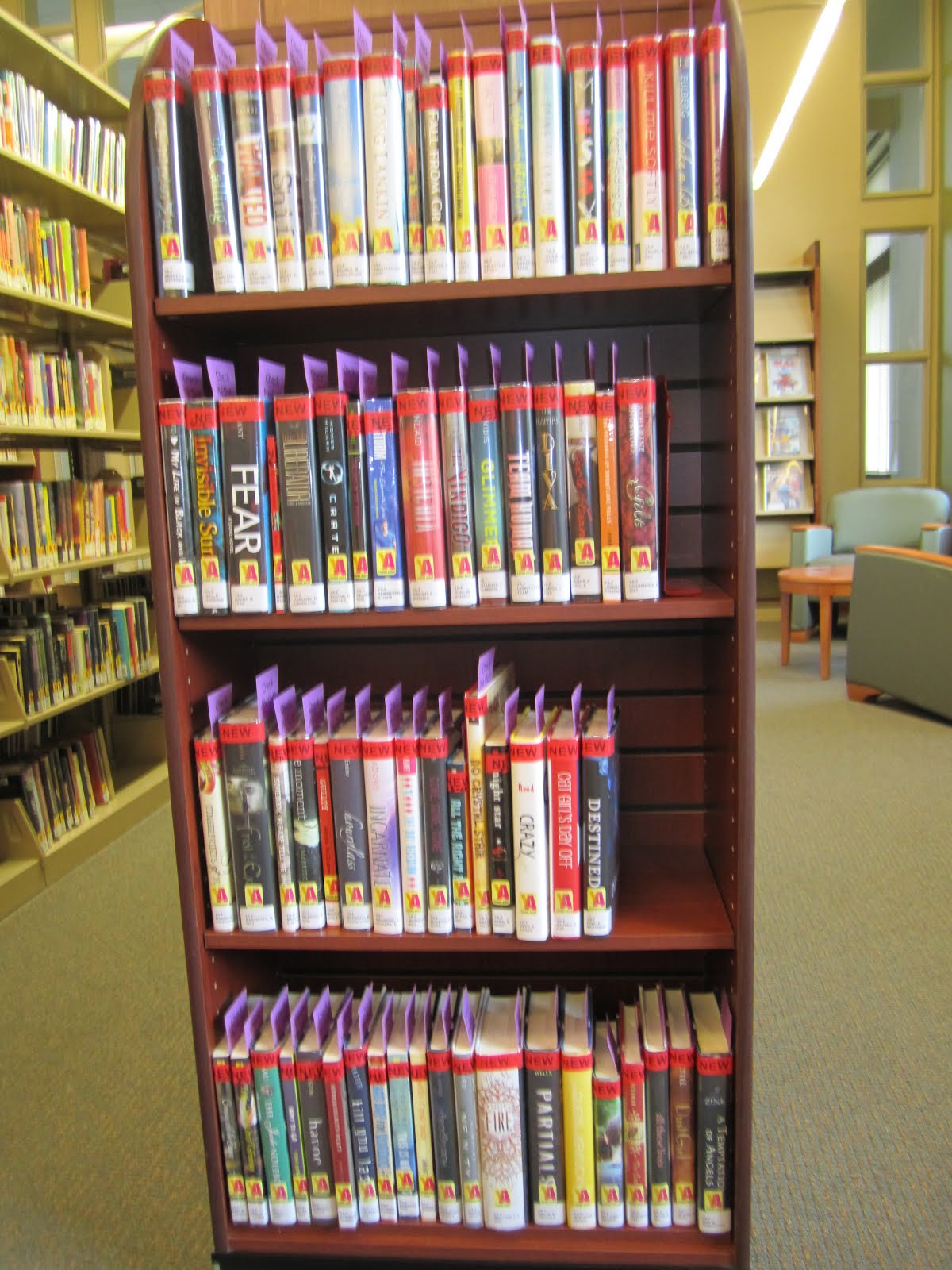
This picture was taken about four hours after we first advertised the program. Already there is more shelf space than there was before...but it's still not much. In a normal scenario the top shelf would be empty/mostly empty so that you can see the sign that labels this area as "New YA Fiction". In an ideal scenario, none of these shelves would be even close to filled and I'd be able to turn a couple of books face-out.

There is another benefit to this promotion: Teens have to come and talk to us to pick up their prize packs. We can use this opportunity to talk of upcoming Teen programs! I'm really hoping to recruit a few more people for my Teen Book Club though this effort.
And who knows, maybe a few teens will discover a new area of the library or a new favorite book through this promotion too!
Tuesday, August 28, 2012
Dear Librarian
I have one last Summer Reading story to share!
At my new library we don't just ask kids to read during the summer. We also give kids the option to do a number of other activities to supplement their summer experience ranging from riding their bikes to doing art projects to visiting a museum. One of the activities that kids had the option to do during the last week of the program was to write a letter to someone.
One of the kids (age 5) in the program decided that he wanted to write a letter to the librarians! He composed the letter and dictated it to his mother who did the writing, but he signed his own name. Here is the letter:

Aww, how sweet!
At my new library we don't just ask kids to read during the summer. We also give kids the option to do a number of other activities to supplement their summer experience ranging from riding their bikes to doing art projects to visiting a museum. One of the activities that kids had the option to do during the last week of the program was to write a letter to someone.
One of the kids (age 5) in the program decided that he wanted to write a letter to the librarians! He composed the letter and dictated it to his mother who did the writing, but he signed his own name. Here is the letter:

Aww, how sweet!
Friday, August 10, 2012
Summer Reading Sign
I was out of town not too long ago visiting my in-laws and saw this sign posted in a neighbor's front yard:

Love it! What a good way to promote the library and summer reading!

Love it! What a good way to promote the library and summer reading!
Thursday, July 26, 2012
Create a Constalation
Last week at our Activity Table we had the coolest project for the kids to do. I can't take credit for the idea - that credit goes to one of my co-workers - but the idea worked out so well that I have to share it.
We decided to have the kids create constellations using black construction paper, foil star stickers, and metallic crayons. We copied diagrams of a few constellations (Orion, Hercules, Cassiopeia, and Cygnus) from a book to help them learn a bit about our night sky. Kids could then use the star stickers to copy one of these constellations onto the black paper. The metallic crayons could then be used to connect the stars and draw out the full image that the stars created.

We asked the kids to try to copy constellations that they would really find up in the sky, but several kids got creative and designed their own constellations. We hung pictures of ladybugs, ice cream cones, dragons, cars, and more!

I loved this project for a lot of reasons, but one of my favorite parts of the project was being able to use these metallic crayons. Have you seen these before? We ordered several boxes of Crayola Metallic FX Crayons out of an art supply catalog and they are super fun to color with. The metallic finish really helps you to imagine that these created constellations are shining up in the night sky. The black paper really shows off the crayons' sheen, and it was very nice to actually be able use our black construction paper for a project!
Just as with the dream drawings activity that I posted about a few weeks ago, kids who completed this activity and showed their picture to the librarian at the desk earned an extra raffle ticket for the big prize drawings. Many kids wanted to take their completed constellations home, but we kept about half of the finished projects to hang in the library.
We decided to have the kids create constellations using black construction paper, foil star stickers, and metallic crayons. We copied diagrams of a few constellations (Orion, Hercules, Cassiopeia, and Cygnus) from a book to help them learn a bit about our night sky. Kids could then use the star stickers to copy one of these constellations onto the black paper. The metallic crayons could then be used to connect the stars and draw out the full image that the stars created.

We asked the kids to try to copy constellations that they would really find up in the sky, but several kids got creative and designed their own constellations. We hung pictures of ladybugs, ice cream cones, dragons, cars, and more!

I loved this project for a lot of reasons, but one of my favorite parts of the project was being able to use these metallic crayons. Have you seen these before? We ordered several boxes of Crayola Metallic FX Crayons out of an art supply catalog and they are super fun to color with. The metallic finish really helps you to imagine that these created constellations are shining up in the night sky. The black paper really shows off the crayons' sheen, and it was very nice to actually be able use our black construction paper for a project!
Just as with the dream drawings activity that I posted about a few weeks ago, kids who completed this activity and showed their picture to the librarian at the desk earned an extra raffle ticket for the big prize drawings. Many kids wanted to take their completed constellations home, but we kept about half of the finished projects to hang in the library.
Sunday, July 22, 2012
Summer Detox
Summer can be a stressful time for children's librarians thanks to the chaos that is the Summer Library Program. I've been so busy this summer that I haven't had much time or energy to devote to sharing my library adventures in this blog. Oops! Don't worry, I have several blog posts planned and I'll have them published as soon as I have the time to put them together.
In the meantime, here are some of the things that this librarian has been doing to keep calm this summer when things get crazy in the children's area:
Chocolate. It is amazing what one mini Recess' Peanut Butter Cup can do to your energy level when you're dragging at 2:00 pm. Chocolate has also been shown to help our body fight stress by reducing the levels of stress-causing hormones in our system.
Ice Cream. Often times I spend a good chunk of my workday talking as I explain the reading program, register kids for special programs, and give kids their prizes. By the end of a busy day my throat is raw and dry, and nothing soothes the throat quite like a cold scoop of ice cream.
Exercise. After a day at the library I like to go for a run or a walk if I can. The fresh air can be refreshing after being inside all day, and the exercise helps your body produce stress-relieving endorphins. Exercise is also important since it helps to burn the calories from the previously-mentioned comfort food.
To-Do Lists. With so much going on at the library, it is very helpful to make myself a to-do list so that I can make sure that everything that needs to be done is actually getting done. It's also very satisfying to cross completed tasks off the list. The sense of accomplishment is important for maintaining the motivation to keep going when the list of things to do seems never-ending.
Hang Out with Grown-Ups. I absolutely love working with children and teens, but at the end of my work day it's nice to go out and have a conversation with an adult. Some sort of activity - going out to dinner, watching a baseball game, etc. - can also provide a much needed mental break and relieves stress much better than vegging on the couch.
Remember. It is very important when things get crazy at the library to pause for a moment and remember why we do what we do during the summer. We're trying to promote literacy for kids during the summer when they aren't in school. We're doing a good thing for these kids, and we want them to come to the library. And not only do we get to promote literacy by encouraging reading, but we also get to have fun doing art projects, hosting cool performers, and playing video games with our patrons. I have the best job ever, so in the end all of the crazy is worth it!
In the meantime, here are some of the things that this librarian has been doing to keep calm this summer when things get crazy in the children's area:
Chocolate. It is amazing what one mini Recess' Peanut Butter Cup can do to your energy level when you're dragging at 2:00 pm. Chocolate has also been shown to help our body fight stress by reducing the levels of stress-causing hormones in our system.
Ice Cream. Often times I spend a good chunk of my workday talking as I explain the reading program, register kids for special programs, and give kids their prizes. By the end of a busy day my throat is raw and dry, and nothing soothes the throat quite like a cold scoop of ice cream.
Exercise. After a day at the library I like to go for a run or a walk if I can. The fresh air can be refreshing after being inside all day, and the exercise helps your body produce stress-relieving endorphins. Exercise is also important since it helps to burn the calories from the previously-mentioned comfort food.
To-Do Lists. With so much going on at the library, it is very helpful to make myself a to-do list so that I can make sure that everything that needs to be done is actually getting done. It's also very satisfying to cross completed tasks off the list. The sense of accomplishment is important for maintaining the motivation to keep going when the list of things to do seems never-ending.
Hang Out with Grown-Ups. I absolutely love working with children and teens, but at the end of my work day it's nice to go out and have a conversation with an adult. Some sort of activity - going out to dinner, watching a baseball game, etc. - can also provide a much needed mental break and relieves stress much better than vegging on the couch.
Remember. It is very important when things get crazy at the library to pause for a moment and remember why we do what we do during the summer. We're trying to promote literacy for kids during the summer when they aren't in school. We're doing a good thing for these kids, and we want them to come to the library. And not only do we get to promote literacy by encouraging reading, but we also get to have fun doing art projects, hosting cool performers, and playing video games with our patrons. I have the best job ever, so in the end all of the crazy is worth it!
Sunday, July 1, 2012
Nocturnal Animals Program
One of my new library's regular summer programs is a hands-on, educational event for school-age kids. The name of this program changes every year depending on the summer theme, and this year we are calling the program Stargazers & Dreamers. Each week we choose a different topic relating to the summer theme and we spend 75 minutes doing art projects, science projects, and other fun activities that help us learn about the subject.
We offer the program twice each week: Once for kids entering grades 2-3, and again for kids entering grades 4-6. The topic and contents for both versions of the program are more or less the same, but we may adjust activities to make them more age-appropriate for each age group. We also require advance registration and generally limit the program to 20 kids - more than that and the group gets to be a bit too large and unmanageable as we cannot provide enough individual attention during these focused activities. The program lasts a total of 75 minutes.
Last week was my first opportunity to lead the program. Our topic for the week was nocturnal animals. We started out with a discussion about the owl and how this animal is specially equipped to hunt at night with it's sharp hearing, keen eyesight, and sharp claws. This then lead into a talk about what kinds of animals owls like to eat, as well as a talk about owl digestion.
Did you know that owls swallow their prey whole? They then digest the fleshy bits and spit up everything that they cannot digest - fur, bones, etc. - in a matted ball that we refer to as a pellet. Our first hands-on activity was to actually dissect one of these pellets and find the bones of whatever creature the barn owl in question might have eaten. I assigned each kid a partner to work with and before we even touched a pellet I asked them to guess how many bones they would find inside their pellet. I had them write out their answers and then post them on the wall so we could remember our guesses later. The picture below shows the guesses made by the 4th-6th graders. The younger group's guesses were much, much lower.

Then I passed out pellets and the groups got straight to work. Some might be interested to know that we purchased the pellets for this program from Copernicus Toys. The pellets came from barn owls and were sterilized to remove the threat of any bacteria. Even with this precaution most of the kids - even those few who had done this activity elsewhere before - were a little grossed out by the pellets. But the feeling passed and most got over the ick factor after a few minutes. We provided toothpicks and tweezers to help the kids pull the matted fur from the bones and I found a chart online that we used to identify what exactly each bone was, though not what kind of animal it came from.


Next we moved on to a very simple craft project: Clothespin Bats. We purchased an Ellison Die which was used to cut out the wing and body shapes. The kids then glued the pieces to a clothespin. Voila! After the craft we moved tables and chairs to clear an open space in the middle of the room to prepare for our final activities.


The activity described next was done with the older group only. The older kids had an easier time getting focused during the owl pellet dissection so they finished more quickly and had time for an activity that we couldn't do with the younger kids. We spent a little bit of time talking about bats and how they are adapted to hunt and otherwise function at night. Naturally, we talked about echolocation. Using this technique, bats send out an ultrasonic signal. They wait for the sound to hit and object and bounce back. The bat can then interpret this echo to identify what the object is and how far away it is.
To demonstrate this unique ability, we played a game that I have dubbed Bats and Moths. The rules of the game are similar to Marco Polo. One child was assigned to be the bat and was blindfolded. Four or five other kids got to be moths and were given shaker eggs with which they could make noise. All of the other kids got to be trees in the forest, forming a ring around the play space. The bat was allowed to clap his/her hands, which represents the bat's ability to send out an ultrasonic signal. In response, the moths had to shake their shakers. The bat's goal is to use this noise to find and "catch" (ie, tag) at least one of the moths. Should a bat wander too close to the edge of the play space, the nearby trees needed to say "tree" (a signal different from the one sent by the moths) to help the bat maneuver in its environment. I also insisted that this be a walking game for safety's sake since we weren't in a huge room. We played several rounds of this game so that each kid had a chance to be either a bat or a moth, and they would have been happy to continue playing for much longer if I had let them!

To conclude the program, we recapped some of the information we had learned and also learned a bit about some other nocturnal animals with a trivia game. The format of the game was identical to the one used in my Titanic program a few months ago. Just like before, I divided the kids up into teams and gave each team colored cards with the answers to all of the questions I might ask. When I asked a question, each team had to search for the correct answer and send it along with a runner across the room to sit in a chair. Each chair was assigned a different number of points. If a team answered correctly they gained the points assigned to that chair. If they answered incorrectly, however, they lost that many points. The great thing about this game is its flexibility. It doesn't require players to have any previous knowledge about the subject at hand, it can be cut short quickly if we run out of time, and we could also use many of the questions as springboards to even more discussion about nocturnal animals.
This was a jam-packed program, but the kids all seemed to have a lot of fun. And I got to learn quite a bit about nocturnal animals myself in the process! Did you know that owls can't roll their eyes in their sockets? That's why their necks are adapted to spin almost all the way around. And did you know that bats have a skeletal structure nearly identical to that of humans? The bones in their wings are actually just like humans' finger bones. It's fun when you can share fun facts like this with a group of kids eager to get their hands dirty.
We offer the program twice each week: Once for kids entering grades 2-3, and again for kids entering grades 4-6. The topic and contents for both versions of the program are more or less the same, but we may adjust activities to make them more age-appropriate for each age group. We also require advance registration and generally limit the program to 20 kids - more than that and the group gets to be a bit too large and unmanageable as we cannot provide enough individual attention during these focused activities. The program lasts a total of 75 minutes.
Last week was my first opportunity to lead the program. Our topic for the week was nocturnal animals. We started out with a discussion about the owl and how this animal is specially equipped to hunt at night with it's sharp hearing, keen eyesight, and sharp claws. This then lead into a talk about what kinds of animals owls like to eat, as well as a talk about owl digestion.
Did you know that owls swallow their prey whole? They then digest the fleshy bits and spit up everything that they cannot digest - fur, bones, etc. - in a matted ball that we refer to as a pellet. Our first hands-on activity was to actually dissect one of these pellets and find the bones of whatever creature the barn owl in question might have eaten. I assigned each kid a partner to work with and before we even touched a pellet I asked them to guess how many bones they would find inside their pellet. I had them write out their answers and then post them on the wall so we could remember our guesses later. The picture below shows the guesses made by the 4th-6th graders. The younger group's guesses were much, much lower.

Then I passed out pellets and the groups got straight to work. Some might be interested to know that we purchased the pellets for this program from Copernicus Toys. The pellets came from barn owls and were sterilized to remove the threat of any bacteria. Even with this precaution most of the kids - even those few who had done this activity elsewhere before - were a little grossed out by the pellets. But the feeling passed and most got over the ick factor after a few minutes. We provided toothpicks and tweezers to help the kids pull the matted fur from the bones and I found a chart online that we used to identify what exactly each bone was, though not what kind of animal it came from.


Next we moved on to a very simple craft project: Clothespin Bats. We purchased an Ellison Die which was used to cut out the wing and body shapes. The kids then glued the pieces to a clothespin. Voila! After the craft we moved tables and chairs to clear an open space in the middle of the room to prepare for our final activities.


The activity described next was done with the older group only. The older kids had an easier time getting focused during the owl pellet dissection so they finished more quickly and had time for an activity that we couldn't do with the younger kids. We spent a little bit of time talking about bats and how they are adapted to hunt and otherwise function at night. Naturally, we talked about echolocation. Using this technique, bats send out an ultrasonic signal. They wait for the sound to hit and object and bounce back. The bat can then interpret this echo to identify what the object is and how far away it is.
To demonstrate this unique ability, we played a game that I have dubbed Bats and Moths. The rules of the game are similar to Marco Polo. One child was assigned to be the bat and was blindfolded. Four or five other kids got to be moths and were given shaker eggs with which they could make noise. All of the other kids got to be trees in the forest, forming a ring around the play space. The bat was allowed to clap his/her hands, which represents the bat's ability to send out an ultrasonic signal. In response, the moths had to shake their shakers. The bat's goal is to use this noise to find and "catch" (ie, tag) at least one of the moths. Should a bat wander too close to the edge of the play space, the nearby trees needed to say "tree" (a signal different from the one sent by the moths) to help the bat maneuver in its environment. I also insisted that this be a walking game for safety's sake since we weren't in a huge room. We played several rounds of this game so that each kid had a chance to be either a bat or a moth, and they would have been happy to continue playing for much longer if I had let them!

To conclude the program, we recapped some of the information we had learned and also learned a bit about some other nocturnal animals with a trivia game. The format of the game was identical to the one used in my Titanic program a few months ago. Just like before, I divided the kids up into teams and gave each team colored cards with the answers to all of the questions I might ask. When I asked a question, each team had to search for the correct answer and send it along with a runner across the room to sit in a chair. Each chair was assigned a different number of points. If a team answered correctly they gained the points assigned to that chair. If they answered incorrectly, however, they lost that many points. The great thing about this game is its flexibility. It doesn't require players to have any previous knowledge about the subject at hand, it can be cut short quickly if we run out of time, and we could also use many of the questions as springboards to even more discussion about nocturnal animals.
This was a jam-packed program, but the kids all seemed to have a lot of fun. And I got to learn quite a bit about nocturnal animals myself in the process! Did you know that owls can't roll their eyes in their sockets? That's why their necks are adapted to spin almost all the way around. And did you know that bats have a skeletal structure nearly identical to that of humans? The bones in their wings are actually just like humans' finger bones. It's fun when you can share fun facts like this with a group of kids eager to get their hands dirty.
Subscribe to:
Posts (Atom)